Tuesday, June 26, 2007

Who doesn't love a pygmy marmoset?

In between the last post and this one, I had a course in Host Defenses. It was a nice course, but generally unremarkable. Except that now, on top of all of the other specialties that I've been certain I'll make a career out of, I've added infectious disease to the list. Do you think they'll let me be an emergency orthopedic neonatologist that specializes in infectious disease?

They would if I worked at Seattle Grace.

So first year is done with, and I've started an eight week research fellowship at the Hospital For Special Surgery. The goals for this summer are two-fold. First, I need to get some research experience under my belt. Strangely, my teaching resume is pretty sparse when it comes to basic science or clinical investigation. Second, I would LOVE to rule out surgery as a future profession. Getting into surgical residencies can be pretty cutthroat... and if I could avoid that, it'd be nice. My hopes that orthopedic surgery will be profoundly unfun spring primarily from two sources.

Source A: I've said it before, and I'll say it again, cutting people open is gross. I remember when I studied abroad in Scotland, I used to walk into their fry shops (shops in which they fry things), and ask them to drop a Mars bar into their frier for me. I can't accurately describe the taste of this beautiful, deep fried, golden brown confection. But I remember that when I bit down on it, I'd pierce its thin, tough fried skin, and out would ooze this melted, gooey, chocolate center. After my first experience watching surgery, I don't think I can eat a deep fried Mars bar ever again. I have a new rule: If something's got skin, the skin should stay on.

Source B: Rumor has it that orthopedic surgeons are misogynistic, weight-lifting, ass-slapping, scalpel jockeys. I did notice that some of the young, male orthopedic attendings who dropped in on our anatomy labs used to spend inordinate amounts of time at the tables of the more attractive female med students. But I have a cousin who's an orthopedic surgeon, and he's not one of those guys, so the jury's still out.

So far this summer, the surgeons and staff that I've met at HSS have been terrific. Funny, down to earth, with just the right amount of ass-slapping.

This week, I've been going to the residents' lectures. It's nice, because I get to get up before 6 am and go sit in a lecture hall and watch powerpoint slides. This morning, as the lecturing pathologist was poring over slide after slide of unhealthy bone, he turned to a slide that looked much like this inset picture. He summarized by saying in the droning monotone he'd used since slide 1, "so if you notice anything in a histological section that shouldn't be there, well, it's probably pathological. Like this, for instance."

Pause, no reaction from the residents.
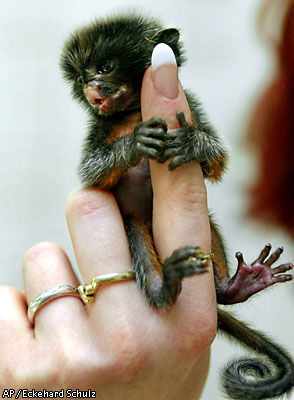
"This baby, pygmy marmoset does not belong on anyone's finger."

Pause, no reaction.

"It belongs on your stethoscope"

...

"In the pediatric wards."

Still nothing.

"They are a... they're a hit."

So, now I'll have to add pathology to the list. Those guys are a riot.

Tuesday, April 17, 2007

Hurts so good

Today was the last day of our Human Structure and Function course. During the closing lecture, one of our professors, Dr. Palmer, offered this quote from Rene Descartes:

"It is not enough to have a good mind; the main thing is to use it well."

Dr. Palmer then told us that we might recognize the quote from the opening lecture, presented by a different instructor, Dr. Maack. Dr. Maack, it seems, felt that the quote was more critical in inspiring students to perform well in the course, whereas Dr. Palmer believes that "one should never put Descartes before the course."

And this comes only a handful of hours after my reflections on punning. Bravo, good sir.

Monday, April 16, 2007

"Words, words, words."

If I've learned nothing else this semester, I've learned this: medical students love puns. Admittedly, punning is not the highest form of comedy, but it's arguably a form of comedy. And, though I feel like I'm standing alone on this one, I have great admiration for puns and punners.

For reasons that aren't entirely clear to me, I've compiled a list of some of the most egregious puns and other acts of wordplay that I've heard on campus. I present them here for your - for lack of a better word - enjoyment.
  • Before even arriving at school, we were invited to a wilderness orientation weekend. The awkwardly formatted name of this trip was both descriptive, and is the common abbreviation for the intracellular signalling molecule "cyclic Adenosine monophosphate." Or "cAMP." Awesome.
  • Our anatomy TA's name was Won. Invariably, when we couldn't find a structure, one of us would cry plaintively, "Is there any Won who could help us?"
  • The name of the school's a Cappella group is The Aneurythms. Though, to be fair to med students, there has never, ever been a cleverly named a Cappella group.
  • Punning does happen to come in handy when naming dodgeball teams. For instance, the season opener will be played by my team, "The Supinators," against the formidable "Smooth Obturators." Though it's not a pun, my favorite team name in the tournament is the aggressive and intimidating, "Incompatible With Life."
  • When asked by an instructor in biochemistry how much we knew about the biological molecule lecithin (pronounced "less-uh-thin") I regrettably remarked, "less uh than you might think." I was told the next day that one of my friends now has that as her away message on IM. And, damn it, I was proud.
And the award for the best pun I've heard all year goes to one of the members of my dissection team who unabashedly spews puns as fervently as I do. The following double pun took place while one of our instructors was trying to clear off some goo in our cadaver to show us an element of the diaphragmatic crus.
  • I say, "Don't you think we could get in there and find the crus ourselves?" To which he replies (...drumroll...) "Hey man, it's her crus to bare."
I know. I know. It's simply beautiful.

Tuesday, March 27, 2007

Bringing Culture Club to the Anatomy Lab

It's difficult for me to describe what it's like to dissect a cadaver. I learned in college that when a project appears difficult, one should do that project poorly or not do it at all. Accordingly, I haven't written anything about gross anatomy. But now, after hearing the outcry of one voice (hi Mom!) wondering forlornly why I haven't posted in WEEKS, I've decided instead to complete my project poorly. Prepare to be either underwhelmed or offended. Maybe even both.

I've been hesitant to write about the dissection of my cadaver, because my description might appear as though I'm unappreciative of those people who've generously donated their bodies to medical schools. That is certainly not the case. Inside the lab, it's almost imperative that the body itself be depersonalized. That's one of the reasons why I consider a whole-body donation such an tremendous act of generosity. Organ donation seems inherently less personal. Most people draw a clear distinction between their liver and their self. Organ donors often rationalize their gift by saying something like, "why not? I'm not using it anymore." It's much harder to draw the same distinction between your body and your self. If your family sees your body on a table, they'll say, "hey, that's Joe! He was a nice guy. I miss Joe." If they see your kidneys there, not even your family would say, "hey those're Joe's kidneys! Those little suckers could really concentrate Joe's urine when he needed it. I really miss Joe's Kidneys." But when a medical student sees either a body or some kidneys, they're not thinking about either in an emotional context. Body donors know this. They know that the student of anatomy, a perfect stranger, isn't remembering the self that once animated their body. Whether or not this makes a prospective donor uncomfortable, they view the education of future healthcare professionals as a more important goal than the clean and pretty burial of their intact husk.

For me and most of my colleagues, dissecting a cadaver has felt peculiarly unstrange. Navigating my way passed 26 tables of corpses on the first day of anatomy, evoked more emotional discomfort than actually working on the bodies. Before the covers were lifted from the cadavers, we were all very aware that underneath lay recently deceased people. We wondered about those people's names, their ages, their lives, and their causes of death - the kinds of things that most people outside of medical school ask me about my cadaver. But once the covers were removed and we started working, those questions rarely came up. Only once has a classmate described to me any emotional connection to the dissection. That student was working on the upper extremities of a cadaver whose fingernails still shone with bright red nail polish.

For the most part, however, cutting those bodies open and identifying, isolating, and cleaning off relevant structures is nearer to boring than emotionally taxing. Sometimes it feels like I'm carving a turkey, but more often it feels like I'm rooting around in an overfull toolbox looking for an instrument that does a job I'm only vaguely familiar with. It's as if someone were rebuilding a car engine and said, "hey, go into my toolbox and grab me a gasket scraper. Oh, and this morning I poured 10 liters of oatmeal in there. My bad."

Cutting people open is a privilege afforded to a very few people. If an MD does it, it's applauded. If an MFA does it, it's assault. Similar rules apply regardless of whether the person being cut open is dead or alive. MFAs aren't allowed to tinker with a corpse without being arrested. Clearly this has nothing to do with the safety of a patient. An MFA couldn't do any harm to my cadaver. IT likely stems from a collective belief that the human body is, at least sort of, sacred. We want to ensure that corpses aren't picked apart unnecessarily. Healthcare students and professionals can learn on bodies, because that's a good enough reason to desecrate a corpse. Funeral directors can cut open a corpse to make it look nicer for the funeral. But nobody thinks it's ok to be opened up by a some guy just because he always wanted to know what someone's insides look like.

So, is it wrong to think of another human as a toolbox filled with oatmeal? Maybe. Should I have restrained myself from speaking to my classmates through the two halves of a sliced-open kidney for an entire 2 hours lab session? Almost certainly. Was singing through the kidney an irrefutably bad idea ("Do you really want to huurt meeee... do you really want to make me cry...)? Of course. But if I were constantly aware of the person on the table, I don't know how effectively I'd be able to teach myself the relevant anatomy. If I were overly concerned with how my cadaver's liver tumors may have affected her relationship with her family, I would be distracted from identifying the vessels supplying that liver. In a sense, I'd be thwarting the intentions of the woman who chose to donate her body to educate medical students.

Monday, March 12, 2007

Five reasons why I almost passed out while watching my first surgery, and a rebuttal by interested parties

#1 It was way too hot in that operating room. Anybody would have felt faint in that heat. Sure the patient was shivering, but she was in surgery. She was losing blood. The rest of us, those of us with all of our blood, we were way too hot.

You only lasted about fifteen seconds into the surgery. By the time you were squatting in the corner, all they’d done is nicked her skin. You lose more blood every time you shave.

#2 And I’m always cold after I shave. Plus, I was wearing one of those gowns. And two pairs of gloves. And these absurd space boots up to my knees. And a face mask with a plastic shield that covered my eyes. It was sweltering under there. As soon as the surgeon made the first cut, that whole shield fogged right up and I couldn’t see. That’s hardly my fault. Those things are a liability.

Those things? The sterile surgical masks? Those are a liability? Were the other folks in the room wearing the same masks?

#3 Of course they were, don’t be ridiculous. That doesn’t mean it’s a good idea that they were wearing them. I mean, what if all of those masked folks overheated and passed out? What then? You have an anesthetized patient lying on a table with unconscious surgeons and nurses splayed out on the floor all around her.

Did everyone else wearing a mask pass out, too?

No, but can you imagine if they did? It’s like that episode of Gray’s Anatomy, when that patient was taking some sort of herbal supplement, and it combined with the drugs in her body and made her blood toxic and it almost killed all of the surgeons at Seattle Grace. It’s like that.

…you should never be allowed in an operating room ever again.

#4 I know, I know. Nobody actually passed out. And most of the surgeons and nurses in the room made it through the whole procedure. BUT! the scrub tech felt nauseous, and she ran out of the room to throw up.

What? Really? Was she overheated? Did her face shield fog up?

#4 No, she wasn’t wearing a face shield. But she said she’d had fried fish for lunch, and SO DID I. I'm not denying that fish and chips is a terrific meal, but probably too heavy for this particular occasion. I ate it way too quickly and didn’t drink anything with it. So I was dehydrated with a stomach full of fish batter.

So you’re saying that the reason you felt squeamish is because of the fish you ate for lunch?

#5 Yeah, mostly. And because cutting people open is disgusting.

Tuesday, February 20, 2007

You know what bore me? Lungs.

The only good thing about lungs is that they keep me from dying. Other than that, they do squat. These enormous tissue-balloons take up way too much space in both my chest and my textbook. In an ideal world, they would plod on with their horrible, Sisyphean fate of inflating and deflating and inflating and deflating without impinging on my consciousness. Alas, I was forced to learn all about these monotonous windbags for the last week and a half. The highlights (of which there are precisely TWO) are as follows:

1. During one particularly painful lab session, some 12 of us were forced to watch one student breathe awkwardly into a computer monitored spirometer. While that was happening, Byron and I sat on the other side of the room and watched an episode of 30 Rock on NBCs website. Sure, we couldn't watch it with any sound, but it was still a much better use of our time than watching readouts of lung function flutter up and down across a computer screen. And that Tracy Morgan is a CARD.

2. Shortly after our computer session came to its riveting conclusion (it turns out, Max's lungs both inflate and deflate), we moved on to a significantly more entertaining lung function lab. To be accurate, it was more of a lung "non-function" lab - maybe that's why it was fun. The dozen of us shuffled out of the computer lab and into a lecture hall. There, we were asked to time each other while holding our breath. It was like med school and third grade summer camp all rolled into one.

After holding our breath, we calculated the changes in the various blood gasses in our circulation. Oxygen levels would drop, carbon dioxide levels would rise - makes sense. It was interesting to note that the sensors in our body that tell us we're suffocating would be, in this case, going berserk due to the high carbon dioxide levels rather than the low oxygen levels. In order to hold our breath for even longer, we'd need to somehow depress the level of carbon dioxide in our blood.

So we hyperventilated for a while before holding our breath. And voila, it worked. After blowing off all that carbon dioxide, we could hold our breath for much longer. Then we ran through some more calculations to discover that, this time, it was the low oxygen levels that compelled us to breathe again. So we decided to see how long we could hold our breath after first hyperventilating then finishing off with a few breaths of 100% oxygen from a tank.

Up until this point one of my classmates, Curtis, had demonstrated a particularly prodigious ability to hold his breath. He went almost two minutes on his first try, then about three minutes after hyperventilating. Curtis drew tremendous attention from the rest of the crowd due to both his lung capacity and his showmanship. Each time Curtis took his final, pre-breath-holding inspiration, he would close his eyes and drop to the ground. There he would sit motionless with his head down until he took that next breath minutes later.

Though there were only a few of us, this session was held in a large auditorium that could seat over a hundred people. As this final chapter of the experiment was about to begin, we all gathered around Curtis at the front of the room. He was hyperventilating and holding an oxygen mask in one hand. When he was ready, he brought the mask to his mouth, took five deep breaths of pure oxygen, closed his eyes, and dropped silently into a seated position on the floor.

As if that were their cue, two doctors in white coats strode into the room. They approached our instructor and explained that there was a developmental biology seminar being held in this lecture hall in a couple of minutes. They looked disapprovingly at Curtis sitting cross-legged and silent beside the lectern. Our instructor told us that we wouldn't have time to calculate the blood gasses for this particular experiment, and that we should pack up our stuff and prepare to leave. So we did. And as the room quickly filled with more and more white-coated, developmental biologists, Curtis remained silent and unmoving at the front of the room.

After about 3 minutes the seats in the auditorium were full. I, along with the other med students, had put on my backpack and moved to the periphery of the hall, leaving Curtis alone at center stage in front of an audience of strangers. And there he sat silently for over seven and a half minutes before finally taking a gasping breath and opening his eyes to a crowd erupting in applause.

Tuesday, February 13, 2007

Cleanliness, Godliness, and... Terror

Recently, Miya and I came home to find piles of furniture wrapped in plastic wrap on our sidewalk. Hooray! Right? Free crap! Right?

Wrong. Never forget to look a gift horse in the mouth. There might be bedbugs in there.

That’s right. This furniture came covered with signs denoting its infestation with bedbugs, which, as we all know, are awful. Unfazed, Miya and I continued into our apartment building and dared those vermin to climb five flights of stairs just to eat us in our sleep.

The good news is that our apartment is still bug-free. The bad news is that our neighbor’s bedbug infestation corresponded almost precisely with our laundromat’s decision to try out a new detergent. So when Miya and I woke up the next morning with irritated bumps and rashes on our arms and feet, we immediately ran out to buy a vacuum cleaner, bed risers, and double-sided carpet tape to begin our war against the bugs.

The good news is that our war against the bed bugs involved a thorough washing of all of our sheets, towels, and clothes with good ol’ Tide. Our skin is no longer irritated, and we have yet to see any bugs in or around our apartment. The bad news is that Dexter is terrified by each of the following: vacuum cleaners, bags filled with anything, frenetic cleaning, leisurely cleaning, and anything being lifted into the air. Sufficed to say, that was a pretty tough day for him, and 24 hours after it had finished, he had still eaten virtually none of his food.


We weren’t all that worried about Dex. He’s a finicky eater with a sensitive stomach, so going a day or only grazing at his bowl is expected on occasion. The previous weekend, we’d watched the Superbowl at our friends’ apartment with our friends’ new kitten, Mukluk. As we all watched the game, Mukluk never once took his eyes off Dexter. Perched safely on his carpeted shelf, the only time the kitten moved at all was to shift slightly to one side to keep Dexter in view whenever he sauntered towards the kitchen. Then, shortly before halftime, Mukluk unleashed an intensely foul, room-clearing stream of kitty-vomit. So I figured, if Mukluk could develop a rancid ulcer during only a couple of hours of football, then Dex’s stomach certainly could have been sufficiently turned during a day of unrestrained cleaning, lifting, and bag-filling.

After about a day and a half of watching Dexter eat only snacks on his walks and Kongs filled wet dog food, Miya – my better, smarter, and more compassionate half – took action. As poor Dex sat on his mat, staring forlornly at his full bowl of food 15 feet away, Miya went to the closet door beside his dish. She opened the closet, pulled out our new vacuum cleaner, and carried it (terrifyingly) to be stored in the other closet, far from Dex’s food.

Dex finished the entire bowl, and a second helping, in a matter of minutes.